





Products Description
When the screw press wastewater treatment system is running, the sludge enters the filter cartridge from the feed port and is pushed by the spiral shaft vanes toward the discharge port. As the pitch between the spiral shaft vanes gradually decreases, the pressure on the sludge increases, and dehydration begins under the influence of the pressure difference. The water flows out through the filter gaps between the fixed and movable rings. Simultaneously, the equipment relies on the self-cleaning function between the fixed and movable plates to clean the filter gap and prevent blockages. After being fully dehydrated, the mud cake is discharged from the discharge port under the push of the spiral shaft.
The screw press wastewater treatment system consists of a spiral stack body, a filter device, a liquid collecting tank, a driving device, a flocculation tank, a supporting frame, and other components. When the sludge dewatering machine is operating, the sludge is pumped to the flocculation tank through the sludge pump, and the chemical flocculant is added via the dosing pump. The stirring motor activates the entire stirring system to mix the sludge and flocculant for full flocculation. Once the liquid level reaches the set line, the spiral stack body begins to work, and the concentrated sludge moves forward continuously with the rotation of the spiral shaft. Under the continuous operation of the spiral driving shaft, the water in the sludge is squeezed out, and the solid content of the filter cake increases, ultimately achieving continuous dehydration of the sludge.
The main body of the spiral stack consists of one or more groups of filter units made up of a spiral driving shaft, multiple fixed rings, and floating rings. As the spiral shaft rotates, it drives the fixed and movable rings to move relative to each other. Under the influence of gravity, water is filtered out through the gaps between the rings to achieve rapid concentration. The concentrated sludge continues to move forward with the rotation of the spiral shaft. Along the direction of the mud cake outlet, the pitch of the spiral shaft gradually decreases, the gap between the rings also decreases, and the volume of the spiral cavity continues to shrink. Under the action of the back pressure plate at the outlet, the internal pressure increases. With the continuous operation of the spiral driving shaft, the water in the sludge is squeezed out, and the solid content of the filter cake increases. The fixed and floating rings in the main body are made of special stainless steel and are specially treated for high wear and corrosion resistance to ensure a long service life.
Metering Tank: The sludge is transported to the metering tank through the sludge delivery pump, with excess sludge flowing back to the sludge storage tank through the return pipe.
Flocculation Mixing Tank: The metered sludge is fully stirred and mixed with the injected high molecular flocculant in the flocculation mixing tank to form a good alum floc.
Dewatering Body: After entering the dewatering body through the mud inlet, the sludge is instantly concentrated by gravity in the concentration section's front area, and most of the filtrate is discharged. In the dewatering section, the sludge undergoes full dehydration due to the continuous increase in internal cavity pressure.
Mud Outlet/Concentrated Sludge Discharge Port: The back pressure plate at the mud outlet generates a blocking force in the opposite direction, further increasing the pressure inside the cavity, ensuring the sludge is more fully dehydrated and discharged from the mud outlet in the form of mud cake. The sludge concentrator discharges concentrated sludge through the mud outlet. No back pressure plate is set on the mud outlet side of the sludge concentrator.
Technical advantages
Equipped with a proprietary disc pre-concentration device, it is highly effective at handling low-concentration sludge. This device addresses the shortcomings of existing gravity-type concentration, achieving efficient concentration of low-concentration sludge while integrating flocculation and concentration, which reduces the pressure on subsequent dehydration. Combined with the adjustable telescopic valve, the inlet sludge concentration can be optimized for the best dehydration performance. The sludge concentration ranges from 2000 mg/L to 50,000 mg/L.
The movable and fixed rings replace the traditional filter cloth, making the system self-cleaning, non-clogging, and well-suited for handling oily sludge. As the spiral shaft rotates, the movable plate of the stacked screw sludge dewatering machine continuously moves relative to the fixed plate, ensuring a continuous self-cleaning process that prevents the common clogging problems of traditional dewatering machines. Therefore, it offers strong resistance to oily pollution, is easy to separate, and does not clog. Additionally, it does not require external water for high-pressure washing, making it clean, environmentally friendly, odor-free, and free from secondary pollution.
The machine operates at low speeds, producing minimal noise and consuming less energy-only one-eighth the energy of a belt press and one-twentieth that of a centrifuge. It relies on internal volume pressure for dehydration and does not require large machines such as drums. With a low operating speed of just 2–4 revolutions per minute, it is energy-efficient and quiet.
The spiral stacking sludge dewatering machine reduces infrastructure investment costs and improves treatment efficiency. It can directly process sludge from the aeration tank and secondary sedimentation tank, eliminating the need for a separate sludge thickening or storage tank. As a result, it reduces overall infrastructure costs, prevents the phosphorus release issues common in traditional sludge thickening tanks, and enhances the dephosphorization capability of the sewage treatment system. It also eliminates the need for investments in infrastructure like thickening tanks, as well as supporting equipment such as mixers, air compressors, and flushing pumps. The equipment has a small footprint, further reducing civil engineering costs for the dewatering room.
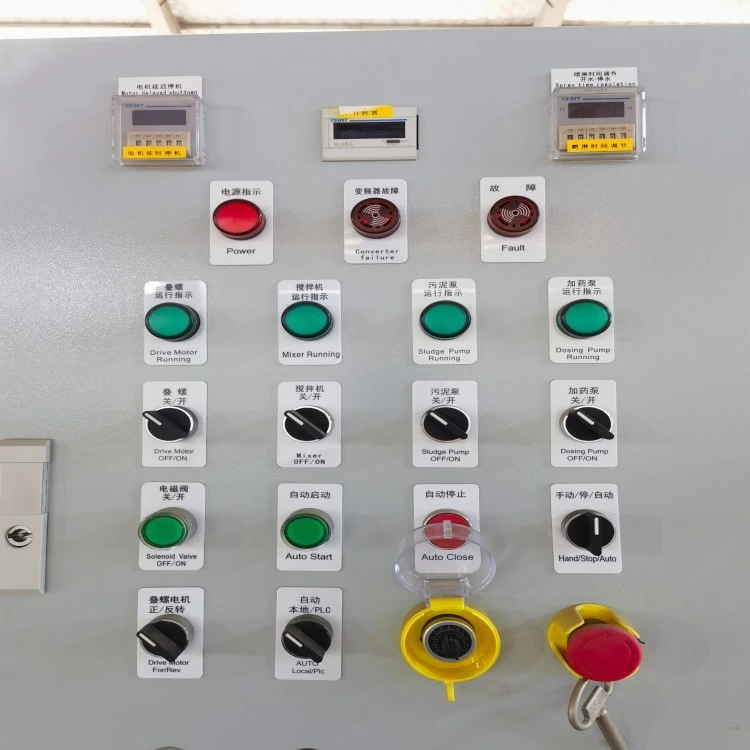
With fully automatic control, the system is easy to operate and manage. There are no filter cloths, filter holes, or other components that are prone to clogging, making operation simple and safe. The system can be set to achieve fully automatic, unattended operation, based on the customer's desired operating schedule, using the automatic control system.
Hot Tags: screw press wastewater treatment, China screw press wastewater treatment manufacturers, suppliers, factory, policy of solid liquid separator, construction solid liquid separator, automatic solid liquid separator, approval of solid liquid separator, beverage solid liquid separator, stationary solid liquid separator

