

Why a tank needs an agitator
In a treatment tank, the mixture of sewage and sludge has to keep moving at a certain speed. If it moves too slowly, the process can't run continuously, and the sludge settles and piles up on the bottom. That cuts the effective volume of the tank, lowers the treatment efficiency and hurts the effluent. An agitator keeps the liquid moving and the sludge suspended.

How it works
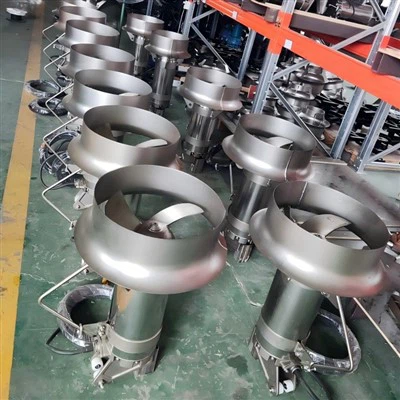
A submersible agitator works fully underwater, around the clock, and combines stirring, mixing and flow-pushing. It has an underwater motor, a reducer on the low-speed series, a propeller and a control system. The motor has overload, leakage and overheat protection. The propeller has a special spiral shape for more thrust.
High-speed series: short blades on a direct-drive, multi-pole motor. It suits stirring liquids with suspended solids in municipal and industrial plants.
Low-speed push-flow series: long blades on a helical gear reducer and a low-power, low-speed motor. It suits aeration and anaerobic tanks, where it keeps the liquid circulating during nitrification, denitrification and phosphorus removal.

Choosing one
First decide where it will work (sewage tank, sludge tank or biochemical tank). Then look at the liquid (solids, temperature, pH), the tank shape and depth, and how you'll install it. Power depends on the volume, density and depth of the liquid, and one or more agitators may be needed. For the choice by tank type, see submersible agitator for wastewater treatment.
FAQ
Is a wastewater agitator the same as a submersible mixer?
Yes. Suppliers use both names.
What stops it if something goes wrong?
Overload, leakage and overheat protection. See the fault lights above.
Hot Tags: wastewater agitator, China wastewater agitator manufacturers, suppliers, factory, agitator for dilution, agitator for distillation, side entry mixer, mixer with blades, agitator for medium scale production, food mixer