

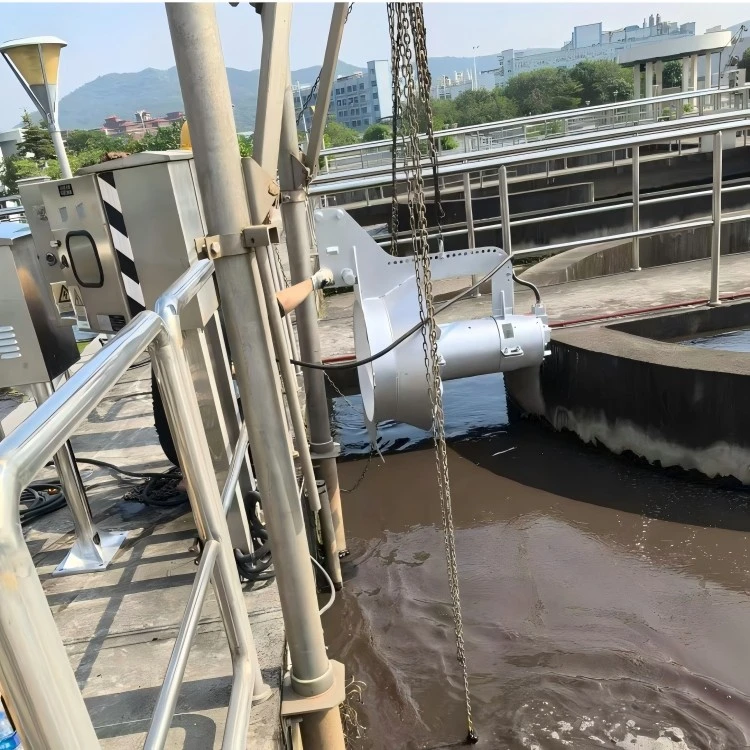


What this pump does
In a nitrogen-removal plant (A²/O, MLE, Bardenpho and similar), the nitrate made in the aerobic zone has to go back to the anoxic zone, where bacteria turn it into nitrogen gas. That return flow is called internal recycle, and it is big. Designers often size it at two to four times the influent flow.
So the job is a lot of water over a very small height difference. An ordinary sewage pump is built for head, not for this, and it isn't an efficient choice. The QJB-W recirculation pump is built the other way around: large flow, low head (up to about 2 m), and wide flow passages that let fibres and solids through. The anoxic zone itself usually needs a submersible mixer for anoxic tanks to keep the sludge in suspension.
How it's built
The pump was developed from the factory's submersible mixer technology. A guide tube around the impeller straightens the flow. For installations that go through a tank wall, we can also supply a wall pipe and a check valve. The wall pipe connects the two tanks. When the pump stops, the check valve closes so liquid can't flow back and the tanks stay separate.
The impeller has backward-swept blades and a wide gap to the guide tube, with no narrow clearances where rags can wedge. The hydraulics were developed with CFD. The impeller sits directly on a slow-speed submersible motor (480–960 rpm depending on the model), so there is no gearbox to wear out.
Motor, seals and protection
Depth and connection. The pump bolts to the wall pipe by flange and can stay submerged continuously at depths up to 20 m without losing watertightness.
Cable. Special watertight cable, 10 m as standard.
Junction box. Fully sealed, and isolated from the surrounding liquid and from the stator chamber.
Motor. A 50 Hz, 3-phase squirrel-cage submersible induction motor with class F insulation and IP68 protection. The surrounding liquid cools the motor, so keep it submerged.
Shaft. Stainless steel, with the rotor dynamically balanced.
Seals. Static seals are O-rings. The shaft seal is a mechanical seal that isolates the oil chamber from the liquid. It has silicon carbide faces on the shaft side and a nitrile rubber (NBR) seal on the motor side.
Bearings. NSK, with a design life of over 100,000 hours.
Oil chamber. The oil lubricates and cools the mechanical seal faces and isolates any liquid that seeps in.
Impeller. Three wide, thin, swept-back blades with a smooth surface. It runs efficiently without clogging and cleans itself.

Technical data
| Model | Outlet (DN) | Flow (m³/h) | Flow (L/s) | Head (m) | Speed (rpm) | Power (kW) | Current (A) | Weight (kg) |
|---|---|---|---|---|---|---|---|---|
| QJB-W-1.5 | 400 | 180–990 | 50–275 | 0.25–0.86 | 740 | 1.5 | 5.8 | 130 |
| QJB-W-2.5 | 400 | 270–1,116 | 75–310 | 0.3–1.02 | 740 | 2.5 | 9 | 135 |
| QJB-W-3 | 400 | 325–1,260 | 90–350 | 0.3–1.15 | 740 | 3 | 11 | 140 |
| QJB-W-4 | 400 | 340–1,650 | 94–458 | 0.35–1.2 | 960 | 4 | 12 | 160 |
| QJB-W-4 | 600 | 360–2,340 | 100–650 | 0.26–1.15 | 480 | 4 | 14.2 | 230 |
| QJB-W-5 | 600 | 415–2,450 | 115–680 | 0.28–1.26 | 480 | 5 | 18.2 | 236 |
| QJB-W-7.5 | 600 | 485–2,735 | 135–760 | 0.35–1.46 | 480 | 7.5 | 28 | 295 |
| QJB-W-10 | 600 | 666–3,000 | 185–833 | 0.42–1.76 | 480 | 10 | 32 | 300 |
| QJB-W-15 | 600 | 954–5,364 | 265–1,490 | 0.4–1.78 | 480 | 15 | 43 | 315 |
| QJB-W-15 | 800 | 954–5,364 | 265–1,490 | 0.4–1.78 | 480 | 15 | 43 | 330 |
| QJB-W-18.5 | 800 | 994–5,670 | 276–1,575 | 0.43–1.82 | 480 | 18.5 | 51 | 350 |
| QJB-W-22 | 800 | 1,044–6,048 | 290–1,680 | 0.44–2.00 | 480 | 22 | 60 | 380 |
Where it's used
Mainly for internal recycle from the aerobic zone to the anoxic zone in A²/O, MLE and Bardenpho-type plants. It also works wherever you need to move a lot of water between tanks with only a small level difference. If you're considering it for return sludge, send us the lift height and we'll tell you honestly whether this pump suits it.
How to choose a size
Work out the recycle flow. Take your average influent flow and multiply by the recycle ratio your process designer specified. As an example, a 10,000 m³/day plant at 300% needs 30,000 m³/day, which is 1,250 m³/h.
Estimate the head. It's the water-level difference between the two zones plus losses through the wall pipe and check valve. For this type of pump it is usually small.
Read the curve at that head. Don't pick from the maximum flow in the table. Check the duty point against the pump curve.
Plan for a spare. Many plants use several smaller pumps instead of one large one, so a single failure doesn't stop denitrification.
Check the pipe size. Confirm the outlet diameter (DN) and, if you need a wall pipe, the wall opening.
Send us your influent flow, recycle ratio, level difference, tank layout (a DWG is ideal), voltage and frequency. We'll recommend a model and quantity.

Installation
The pump hangs on a guide rod that lets you lift, rotate and adjust the angle. You can pull it out for inspection without draining the tank.
Warranty and support
12-month warranty, starting from commissioning. If a part fails during that time because of a defect, we send a replacement free of charge and cover the shipping. Wear parts are not covered.
FAQ
How is this different from a normal sewage pump?
A sewage pump is designed to push water against high head. A recirculation pump is designed to move very large volumes against almost none. For internal recycle, that's the right match.
Is it for internal recycle or return sludge?
It's designed for internal recycle (mixed liquor recirculation). For return activated sludge, tell us the lift and we'll advise.
Do you supply the wall pipe and check valve?
They're optional extras and are not included in the standard installation kit. If you need them, tell us when you ask for a quote and send the wall thickness and opening size.
SS304 or SS316?
SS304 is standard. SS316 is available for more corrosive or high-chloride wastewater.
What voltage does it run on?
Standard is 380 V, 3-phase, 50 Hz. We can supply 400 V, 415 V, 220 V and other voltages on request.
Can I remove the pump without draining the tank?
Yes. On the guide rod it can be lifted out for inspection or repair.
How do I choose the model and quantity?
Send your flow, recycle ratio, tank layout and electrical supply. We'll recommend the right size.
Hot Tags: submersible recirculation pump, China submersible recirculation pump manufacturers, suppliers, factory, turbine agitator, helical mixer, mixer for emulsion, mixer for viscous materials, paddle agitator, agitator for emulsion


