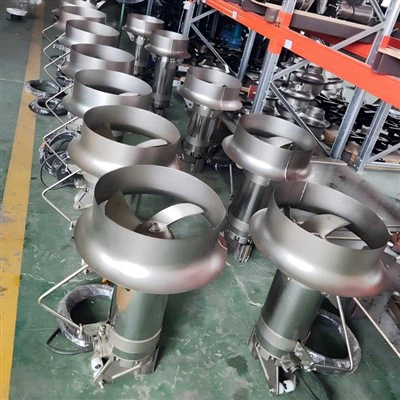


Products Description
A submersible mixer is used to keep wastewater and suspended solids moving inside a treatment tank. By creating a controlled flow, it helps prevent sludge from settling in unwanted areas and keeps the tank contents more evenly mixed.
In wastewater treatment plants, mixers are commonly installed in anoxic tanks, anaerobic tanks, equalization tanks and other process units where circulation is needed. The required mixing intensity depends on the tank dimensions, liquid depth, wastewater characteristics and treatment process.
Our submersible agitator mixers are available in different motor powers, impeller diameters and rotational speeds. Model selection should be based on the actual working conditions rather than motor power alone.
We can help select a suitable model after reviewing your tank dimensions, wastewater characteristics and electrical requirements.

How Does a Submersible Mixer Work?
The motor drives a propeller-type impeller, which produces water flow inside the tank. The resulting circulation helps distribute suspended solids and maintain a more uniform mixture.
The purpose is not simply to stir the liquid near the equipment. The mixer must generate enough circulation to cover the required mixing area without creating unnecessary turbulence or consuming more power than the process requires.
For this reason, impeller diameter, rotational speed, thrust and installation position all need to be considered when selecting a mixer.
Applications in Wastewater Treatment
Anoxic Tanks
In biological nitrogen removal systems, submersible mixers keep activated sludge suspended while maintaining circulation through the anoxic tank. Adequate mixing helps bring the wastewater, biomass and available carbon source into contact without relying on continuous aeration.
The mixer should provide sufficient circulation while avoiding excessive air entrainment, which may interfere with anoxic conditions.
Anaerobic Tanks
Mixers can be used to distribute wastewater and maintain contact between the liquid and suspended biomass in anaerobic process tanks. The required mixing intensity depends on the reactor design and the characteristics of the sludge.
Mixing equipment should be selected to suit the process rather than assuming that every anaerobic tank requires the same arrangement.
Equalization Tanks
Wastewater flow and composition can change considerably throughout the day. A mixer helps distribute incoming wastewater and reduce localized accumulation of suspended solids.
The required equipment depends on the tank volume, solids content, variation in wastewater characteristics and the degree of homogenization required.
Aeration Tanks
In aeration tanks, mixers may be used where additional circulation is needed or where the tank geometry creates poorly mixed areas. Their role should be assessed together with the aeration system.
A mixer does not replace the oxygen supply required for biological treatment. Any effect on oxygen transfer or overall energy consumption depends on the complete system design and operating conditions.
Other Industrial Wastewater Applications
Submersible mixers may also be suitable for industrial wastewater equalization, sludge-containing process tanks and other applications that require liquid circulation.
For corrosive wastewater or liquids with unusual solids content, material compatibility and the risk of impeller fouling should be reviewed before choosing a model.
Submersible Mixer Models and Technical Specifications
The following table lists representative models and their technical parameters.
|
Model |
Rated power(KW) |
Rated current(A) |
Blades diameter(mm) |
|
QJB0.37/6-220/3-960 |
0.37 |
1.3 |
220 |
|
QJB0.85/8-260/3-740 |
0.85 |
4 |
260 |
|
QJB1.5/6-260/3-960 |
1.5 |
4 |
260 |
|
QJB1.5/8-400/3-740 |
1.5 |
5.8 |
400 |
|
QJB2.5/8-400/3-740 |
2.5 |
9 |
400 |
|
QJB3/8-400/3-740 |
3 |
11 |
400 |
|
QJB4/6-400/3-960 |
4 |
12 |
400 |
|
QJB4/12-620/3-480 |
4 |
14.2 |
620 |
|
QJB5/12-620/3-480 |
5 |
18.2 |
620 |
|
QJB7.5/12-620/3-480 |
7.5 |
28 |
620 |
|
QJB10/12-620/3-480 |
10 |
32 |
620 |
|
QJB15/12-620/3-480 |
15 |
43 |
620 |
|
QJB18.5/12-620/3-480 |
18.5 |
51 |
620 |
|
QJB22/12-620/3-480 |
22 |
60 |
620 |
|
Model |
RPM |
Weight(kg) |
Force(N) |
|
QJB0.37/6-220/3-960 |
960 |
45 |
138 |
|
QJB0.85/8-260/3-740 |
740 |
55 |
180 |
|
QJB1.5/6-260/3-960 |
960 |
55 |
260 |
|
QJB1.5/8-400/3-740 |
740 |
100 |
600 |
|
QJB2.5/8-400/3-740 |
740 |
100 |
800 |
|
QJB3/8-400/3-740 |
740 |
100 |
920 |
|
QJB4/6-400/3-960 |
960 |
100 |
1200 |
|
QJB4/12-620/3-480 |
480 |
184 |
1400 |
|
QJB5/12-620/3-480 |
480 |
184 |
1800 |
|
QJB7.5/12-620/3-480 |
480 |
229 |
2600 |
|
QJB10/12-620/3-480 |
480 |
229 |
3300 |
|
QJB15/12-620/3-480 |
480 |
260 |
4000 |
|
QJB18.5/12-620/3-480 |
480 |
276 |
4400 |
|
QJB22/12-620/3-480 |
480 |
290 |
5300 |
Materials and Available Configurations

The correct material and electrical configuration depend on the wastewater and the installation conditions.
Impeller and structural materials: Stainless steel options such as SS304 and SS316 are available for suitable configurations. The appropriate grade depends on the wastewater composition and corrosion conditions.
Motor insulation: Class F or Class H options can be discussed according to the selected model.
Electrical supply: Voltage, frequency and phase should be confirmed against the project requirements.
Cable configuration: Cable cores and protective functions depend on the selected configuration. Options may include leakage detection and motor overheat protection.
Installation accessories: Guide-rail or fixed-base arrangements can be considered according to the tank structure and maintenance requirements.
Please confirm the available configuration for your selected model rather than assuming that every option is standard across the full product range.
Installation and Maintenance
The mixer should be positioned to provide effective circulation throughout the intended mixing zone. Tank geometry, liquid depth, obstructions, inlet and outlet locations, and the presence of other equipment can all affect the final arrangement.
Two common installation approaches are:
Guide-rail installation: The mixer is mounted on a guide system that allows it to be lowered into the tank and retrieved for inspection or maintenance. This arrangement can be useful where the tank should not need to be drained for routine equipment removal.
Fixed-base installation: The mixer is secured to a base or support structure at a specified position in the tank. The support must suit the equipment loads and site conditions, and sufficient access should be provided for maintenance.
Before installation, check the mounting dimensions, support arrangement, cable routing and electrical connections. The equipment should be operated within the manufacturer's specified limits.
Regular maintenance should follow the operation manual and may include checking the cable and seals, inspecting the impeller for damage or fouling, and monitoring motor current and abnormal vibration or noise.
Model Selection and Engineering Support
Choosing a mixer based only on tank volume or motor power can lead to poor circulation or unnecessary energy consumption. A more reliable selection considers the tank layout and the actual mixing requirement.
To help us recommend a suitable model, please provide:
Tank length, width and operating liquid depth
Wastewater type and approximate suspended-solids content
Process application, such as anoxic mixing or equalization
Required voltage, frequency and phase
Preferred materials, if specified
Installation preferences or an existing tank layout
Any required circulation, thrust or mixing-performance criteria
Based on the information available, we can review suitable models and provide relevant technical specifications, drawings and installation information. More complex applications may require additional engineering assessment.
Quality Control and Technical Documents
Before purchasing, buyers should confirm that the proposed equipment matches the project specifications and installation requirements.
Relevant documentation can include model specifications, dimensional or installation drawings, the operation manual and available factory test records. Testing and inspection arrangements should be confirmed for the particular order.
We can provide the applicable technical documents for review so that the selected mixer can be checked against the project's electrical, mechanical and installation requirements before shipment.
Frequently Asked Questions
1. How do I choose the right submersible mixer?
Start with the tank dimensions, liquid depth, process application and wastewater characteristics. The required mixing intensity, impeller diameter, rotational speed and installation position should then be considered together. Send us your tank layout and operating conditions for a model recommendation.
2. Can the mixer be supplied in SS304 or SS316?
Material options depend on the selected model and its construction. SS304 and SS316 can be considered where suitable, but the choice should account for the wastewater's chemical composition, chloride content, temperature and other corrosion factors.
3. Can you supply a mixer for a specific voltage or frequency?
Electrical configurations should be confirmed before ordering. Please provide the site's voltage, frequency and phase so that we can check the appropriate motor configuration.
4. Can the mixer be removed for maintenance without draining the tank?
A suitable guide-rail arrangement can allow the mixer to be retrieved for maintenance without entering the tank or draining it in many installations. The feasibility depends on the tank structure, lifting arrangement and equipment configuration.
5. What information is needed for a quotation?
Please provide the required quantity, model or motor power, tank dimensions, wastewater application, electrical supply, material requirements and delivery destination. If the model has not yet been selected, a tank drawing and basic process information will help us review the options.
6. Can you provide drawings and an operation manual?
Applicable technical drawings and operation documentation can be provided for the selected model. Please specify any project-specific documentation requirements when requesting a quotation.
Request a Submersible Mixer Selection
Looking for a submersible mixer for a new wastewater treatment project or equipment replacement?
Send us your tank dimensions, process application and electrical requirements. We will review the available models and help identify a suitable configuration for your operating conditions.
Contact us for model selection, technical specifications and a quotation.
Hot Tags: submersible mixer for wastewater treatment, China submersible mixer for wastewater treatment manufacturers, suppliers, factory, agitation equipment, agitator for concentration, agitator for mixing chemicals, agitator for process industry, mixer for mixing cement, paddle agitator